
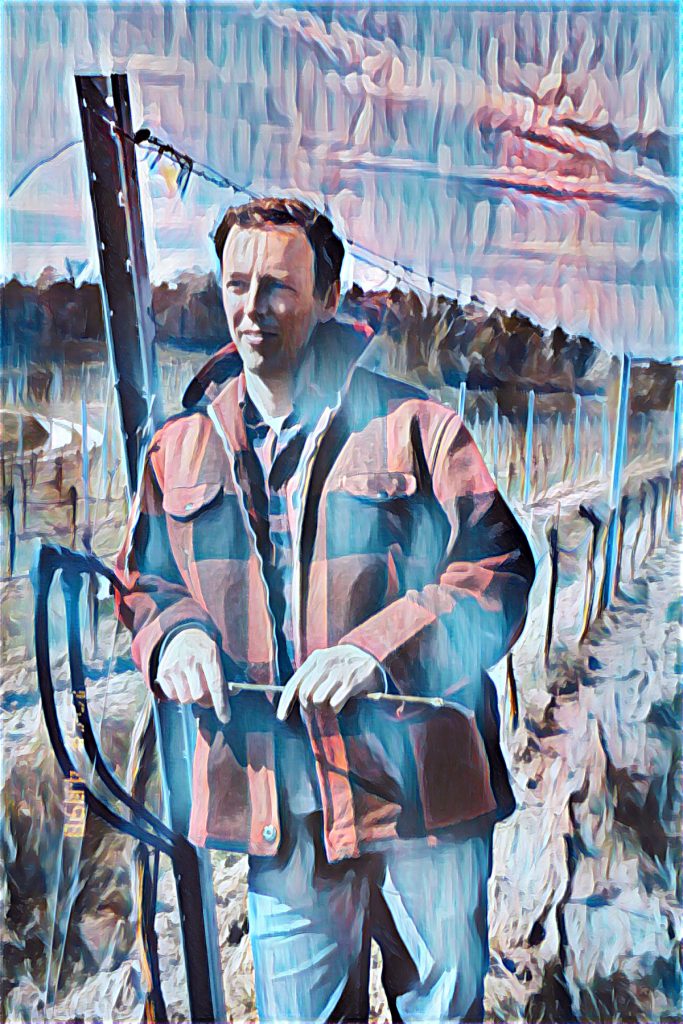
Robert Bormuth is the founder and winemaker of Feldtheorie (“Field Theory”) in the Kamptal region of Austria. He runs the winery with his partner, Ulrike “Uli” Filp. Both trained as scientists—Robert in physics and Uli in chemistry—and were pursuing PhDs in Amsterdam when a chance encounter with the owners of Māori Point Vineyards in New Zealand sparked their interest in wine.
After working harvests at boutique organic wineries in Germany, Australia and Austria, Robert settled in Austria and began searching for their own vineyard. They eventually found three hectares of mostly old vines in historically important Kamptal sites, with an unusually high proportion of red varieties. Feldtheorie’s first vintage was 2022. Today, Robert (and Uli) run the small organic winery with the help of family and friends.
Media Inquiries: Robert Bormuth weingut@feldtheorie.at | https://www.feldtheorie.at/
What’s the ONE THING most unique, authentic, & memorable about your brand?
Our winery and winemaking are shaped by our previous careers in science, though perhaps not in the way people expect. We left behind numbers, laboratories and lectures to learn winemaking by doing—traveling the world for harvests, working in vineyards and cellars, and adapting to the seasons. For us, the transition was liberating.
What we brought from science are two principles: Occam’s razor—the pursuit of simplicity and elegance—and a fascination with the underlying structures that shape our world.
The first guides our winemaking: remove anything unnecessary. We farm organically and do the work ourselves, using minimal intervention in the cellar. The second drives our fascination with terroir. Because its expression is subtle and seasonal, we believe the best approach is to step back and let the vineyards and grapes speak.
Describe how and what you’d do with your winemaking career or winery business if you were not constrained.
The realities of the wine market are the hardest thing for us to wrap our heads around, so we are happy to leave them as they are. Growth has never been a topic for us as 10 acres are plenty of work, and we want to be involved every step along the way. A nice winery with a tasting room is something one jumps to automatically, but in many ways our historic cellar allows for a more authentic visit.
Rather, the big change for us would be to pay back all the trust and opportunity given to us by other winemakers during our years learning the trade. Hence, our biggest wish is to offer apprenticeships to other enthusiastic people, to teach them and be taught by them. So our big dream would be to have the opportunity to offer housing and decent compensation to as many people as possible, throughout the season. Making our winery a hub for the exchange of ideas and experiences in the world of international traveling winemakers.
What is the One Wine most emblematic of your brand and/or winemaking style? Tell us its story.
This is a very personal and difficult question, but I would choose our Pinot Noir. Choosing a red to represent us might be controversial in Kamptal, better known for Grüner Veltliner and Riesling, which we also make. But this small plot was one of the main reasons we took on the vineyard and holds a special place in my heart.
At nearly 50 years old, these are the oldest Pinot Noir vines in the Kamptal. Their age makes them special, but so does the site—a north-facing slope overlooking the valley. The vines themselves are wonderfully individual. Some resemble antlers, others tiny bonsai trees, and a few look like gymnasts celebrating a perfect landing. I spend many winter hours pruning them, and every vine presents a new challenge. The combination of these remarkable old vines, their unique site and the wine they produce makes this Pinot Noir the natural choice to represent Feldtheorie. Stay tuned, this wine review is coming soon!
Bonus Question: If you could create your own superpower, what would it be?
I would love to have the superpower to make people talk to me straight and in earnest, similar to the Lasso of Truth, the weapon wielded by Wonder Woman. Ever since entering the world of wine, the lack of honest exchange among colleagues, partners and consumers has left me puzzled. The scientific culture is very open and direct, with honest feedback and discussions with well-reasoned arguments. I find the lack thereof in the wine world frustrating. How am I to learn more if my peers do not talk to me in good faith regarding our profession? What should I think about my wines when consumers are too shy to give honest feedback? Therefore my super power, I rather want to hear the full and honest truth over a comforting statement.